
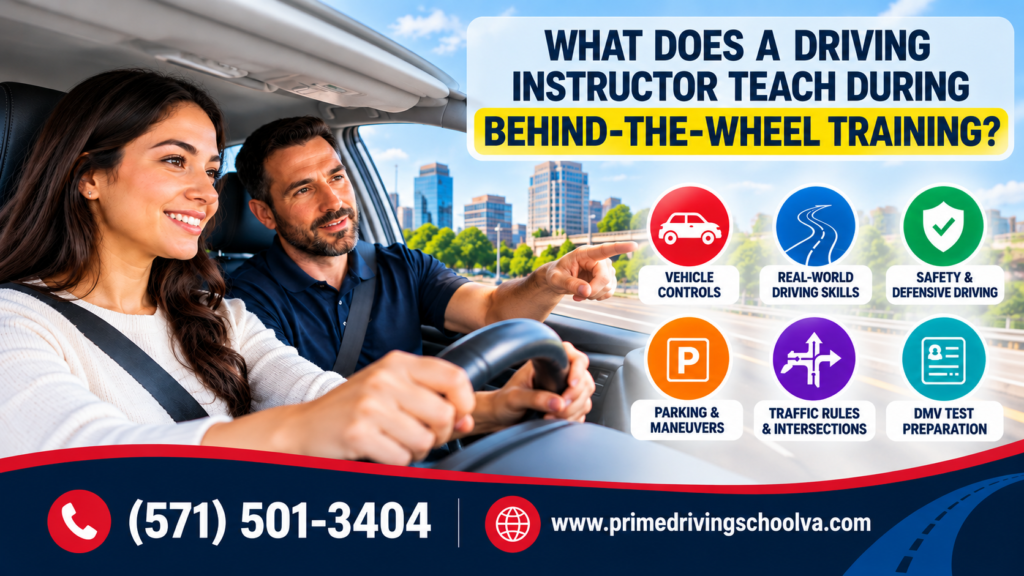
Learning to drive involves more than knowing how to start a car, press the brake, and turn the steering wheel. A professional instructor helps students develop practical skills that support safe and confident driving. For adults especially, structured training can make the learning process easier because each lesson can focus on specific skills and real-world situations.
When adults search for a driving school near me for adults, they often want more than a few hours behind the wheel. They want an instructor who can explain each skill clearly, correct mistakes early, and help them understand how to make safer decisions on Virginia roads. A DMV-licensed driver training school can provide structured education and in-car instruction that supports the licensing process. The Virginia DMV states that licensed driver training schools provide driver education programs to residents of all ages.
What Happens During Behind-the-Wheel Training?
Behind-the-wheel training gives students the opportunity to apply driving knowledge in an actual vehicle. The instructor observes how the student handles the car, responds to traffic, follows road rules, and makes decisions.
Virginia dmv approved driving schools includes seven driving sessions, seven observation sessions, and a final road skills examination. Each in-car session lasts 50 minutes.
The exact lesson plan can vary based on the student’s experience, age, confidence, and current skill level.
1. Vehicle Controls and Basic Operation
Learning the Car Before Entering Traffic
A good instructor starts with the fundamentals. Students learn how to adjust the seat and mirrors, understand basic controls, use turn signals, operate the pedals, and maintain proper steering control.
The instructor may also explain how to check the vehicle before driving. This can include checking mirrors, seat belts, lights, and other essential equipment.
These simple habits help students feel more comfortable before they face complicated traffic situations.
2. Steering, Speed and Braking
Smooth vehicle control forms the foundation of safe driving.
An instructor teaches students how to:
- Maintain steady steering
- Accelerate gradually
- Brake smoothly
- Control speed based on road conditions
- Maintain a suitable position within the lane
- Stop at the correct location
The goal is not simply to operate the vehicle. Students need to understand how their actions affect the safety and comfort of everyone around them.
3. Mirrors and Blind-Spot Awareness
Developing Better Road Awareness
New drivers often focus heavily on the road directly ahead. An instructor helps expand that awareness.
Students practice checking:
- Rear-view mirrors
- Side mirrors
- Blind spots
- Nearby vehicles
- Pedestrians and cyclists
- Changing traffic conditions
The instructor also explains when students should check mirrors and blind spots before changing lanes, turning, merging, or moving away from a parked position.
4. Turns, Intersections and Right-of-Way
Intersections can create difficult decisions for inexperienced drivers.
During training, instructors teach students how to approach intersections, read traffic signals and signs, identify other road users, and make safe turns.
Students also learn how right-of-way works in different situations. Instead of memorizing isolated rules, instructors can explain how to observe the complete traffic situation before making a decision.
5. Lane Changes and Traffic Positioning
Changing lanes requires more than turning on a signal.
Students learn a repeatable process that includes checking mirrors, checking blind spots, using the signal, judging traffic gaps, and moving smoothly when conditions allow.
An instructor can also identify habits such as drifting within a lane, checking mirrors too late, or changing lanes without enough space.
6. Parking and Low-Speed Maneuvers
Parking gives instructors an opportunity to teach precise vehicle control.
Depending on the student’s needs, lessons may include:
Common Parking Skills
- Parking in a marked space
- Reversing safely
- Controlling the vehicle at low speed
- Checking surrounding areas
- Maintaining awareness of pedestrians
- Positioning the vehicle correctly
The instructor can break complicated maneuvers into smaller steps so the student can repeat them with less stress.
7. Defensive Driving and Hazard Awareness
Professional instruction should also prepare students for situations that do not follow a predictable pattern.
Virginia DMV’s driver education program includes topics such as distracted driving, aggressive driving, pedestrian and bicycle safety, motorcycle awareness, and other transportation-safety subjects.
During practical lessons, instructors can help students recognize potential hazards before they become immediate problems. This encourages better observation and decision-making.
8. Handling Mistakes Safely
Mistakes can happen while learning.
A useful instructor does not simply point out an error. They explain what happened, why it created a risk, and what the student can do differently next time.
For example, if a student approaches a turn too quickly, the instructor can explain how earlier speed control and observation could create more time to respond.
This approach turns mistakes into learning opportunities.
9. Preparing for Virginia Licensing
Behind-the-wheel training can also support the broader Virginia licensing process.
Virginia DMV explains that driver education programs help students gain skills and experience needed for the driving test while building safe driving habits.
Current requirements vary by age and individual circumstances. For example, Virginia has different driver education and learner’s permit requirements for drivers under 18 and adults. Beginning January 1, 2027, Virginia will also apply revised requirements for certain first-time drivers ages 18 and older.
Students should always confirm their specific requirements directly with Virginia DMV because licensing rules can change.
How Can You Tell If Your Driving Skills Are Improving?
Progress does not only mean driving for more hours. Look for measurable improvements.
You may be progressing when you can:
- Control speed without frequent instructor reminders
- Check mirrors consistently
- Identify blind spots
- Make turns with better positioning
- Judge traffic gaps more confidently
- Respond calmly to unexpected situations
- Follow signs and signals consistently
- Complete basic maneuvers without constant guidance
Your instructor can help identify the skills that still need attention.
Frequently Asked Questions
What does a driving instructor teach first?
Most instructors begin with vehicle controls, seating and mirror adjustment, steering, acceleration, braking, and basic observation. The lesson then progresses according to the student’s skill level.
How long is a behind-the-wheel driving lesson in Virginia?
Virginia’s state driver education program uses 50-minute in-car sessions. The approved program includes seven driving sessions and seven observation sessions.
Can adults take driver education in Virginia?
Yes. Virginia DMV states that driver education programs are available to residents of all ages, and DMV-licensed driver training schools may provide training to adults.
Can driving lessons help with the Virginia road skills test?
Yes. Professional training can help students practice vehicle control, observation, lane positioning, turns, parking, and other practical driving skills. Virginia DMV also requires specific documentation and vehicle requirements for the road skills test.
How should I choose a driving school for adult training?
Check whether the school is licensed by Virginia DMV, ask about instructor qualifications, training vehicles, lesson schedules, cancellation policies, and the types of training offered. Virginia DMV specifically recommends checking instructor licensing and asking about training vehicles and school policies.
Build Practical Skills With Professional Training
Behind-the-wheel instruction gives learners a structured way to turn driving knowledge into practical habits. For adults, the right training can provide clear feedback, gradual skill development, and practice in situations that they may find difficult on their own.
If you are comparing best driving schools for adults near me Arlington VA, look beyond convenience alone. Consider DMV licensing, instructor qualifications, training structure, vehicle standards, and how well the program matches your current driving experience and licensing goals. Virginia DMV recommends choosing a licensed driver training school that provides quality education and employs professional, respectful, and knowledgeable instructors.