
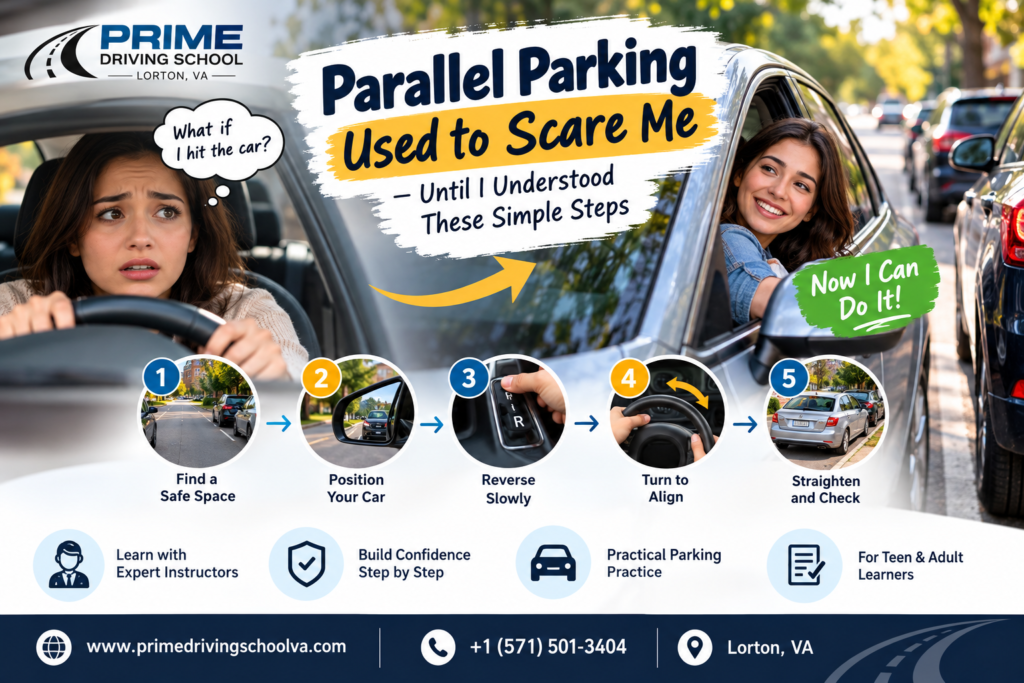
Have you ever found the perfect parking spot, only to drive past it because you were afraid to park between two cars? You are not alone. For many new drivers, parallel parking feels harder than driving on a normal road. The steering seems confusing, the space looks too small, and the fear of hitting another car makes every move stressful.
For learners looking for parallel parking lessons Lorton VA, the good news is that this skill becomes easier when you understand the steps, practice slowly, and learn how to judge the space around your vehicle. You do not need perfect skills on your first attempt. You need patience, clear guidance, and a safe place to practice.
My First Parallel Parking Attempt: A Story Every New Driver Understands
I used to think parallel parking required some special talent. Whenever I saw a space between two parked cars, I worried about scratching a bumper or getting stuck at an awkward angle. Even when the space looked large enough, I hesitated.
One afternoon, I decided to try again in a quiet practice area with a patient driving instructor. Instead of rushing me, the instructor asked me to focus on three things: my starting position, the direction of the steering wheel, and the space around the car.
That simple advice changed my approach. I stopped trying to complete the entire maneuver in one quick movement. I began treating it as a series of small, controlled steps.
My first attempt was not perfect. I parked too far from the curb and needed to adjust my position. But I learned something important: a mistake during supervised practice can help you understand what to improve. With repeated practice and useful feedback, the maneuver started to feel less intimidating.
This is an illustrative learner story designed to reflect common beginner challenges, not a real student testimonial.
How to Parallel Park: 5 Simple Steps for Beginners
The following steps provide a general guide. Vehicle dimensions, visibility, road layout, and local conditions can affect the maneuver, so learn the technique with a qualified instructor before trying it in traffic.
Step 1: Find a Safe, Suitable Space
Choose a legal parking space with enough room for your vehicle. Check the surrounding traffic, pedestrians, cyclists, signs, and curb before you begin. Signal your intention and stop only when it is safe to do so.
If another vehicle follows too closely, do not stop suddenly just to claim a space. Continue safely and look for another opportunity.
Step 2: Position Your Car Carefully
Pull alongside the vehicle parked in front of the space, leaving a safe gap between the vehicles. A common teaching reference is roughly two to three feet, but your instructor may adjust the starting position based on the vehicles and the available space.
Check your mirrors and surroundings before shifting into reverse. Do not rely on mirrors alone because they cannot show every area behind your car.
Step 3: Reverse Slowly Into the Space
Begin reversing at a very low speed while checking behind you and around the vehicle. Use the steering input your instructor teaches you to guide the rear of the car into the space.
Pause whenever you feel uncertain. Look for pedestrians, cyclists, moving vehicles, and obstacles. Never let pressure from waiting drivers make you rush.
Step 4: Turn the Steering Wheel to Align the Car
As your rear wheels enter the space and your front end clears the vehicle ahead, follow your instructor’s guidance to steer in the opposite direction. This helps bring the front of your vehicle into the parking space.
Make small adjustments when needed. Avoid focusing on only one mirror or one reference point. Check your surroundings throughout the maneuver.
Step 5: Straighten the Wheels and Check Your Position
Once your vehicle sits parallel to the curb, straighten the wheels and check your distance from the curb and nearby vehicles. Virginia’s Driver’s Manual says drivers should park close to the curb and no more than one foot away when parking beside a public road.
Secure the vehicle before leaving it. Check for traffic and cyclists before opening the door.
Common Parallel Parking Mistakes and How to Improve
New drivers often make the same mistakes. Recognizing them early can make practice more productive.
- Turning too early: Follow a consistent reference point taught by your instructor rather than guessing.
- Reversing too quickly: Keep the vehicle moving slowly enough to stop immediately when needed.
- Watching only the mirrors: Check all available views and look directly around the vehicle when safe.
- Getting too close to another car: Stop, reassess your position, and correct it when safe.
- Panicking after a poor attempt: Take a breath, identify what went wrong, and repeat the maneuver in a safe practice area.
Remember, the goal is not to park quickly. The goal is to park safely, legally, and with control.
Why Guided Practice Can Make Parking Easier
Reading instructions can help you understand the process, but practical experience helps you judge distance, steering, and vehicle movement. A qualified instructor can observe your technique, explain errors, and help you build safer habits at a pace that suits your experience.
Prime Driving School’s Lorton page lists teen and adult driver training, individual lessons, and practice focused on parking and other driving skills. Learners can ask about a session that focuses specifically on parallel parking and their current challenges.
You can explore the available options on the Prime Driving School Lorton page.
Frequently Asked Questions About Parallel Parking
Is parallel parking difficult for beginners?
It can feel difficult at first because it requires steering control, distance judgment, and awareness of nearby traffic. Breaking the maneuver into small steps and practicing with qualified guidance can help.
How long does it take to learn parallel parking?
There is no fixed timeline. Some learners understand the basic movement quickly, while others need several sessions. Progress depends on practice, confidence, vehicle size, and instructor feedback.
Can I practice parallel parking before my DMV road test?
Yes, if you meet Virginia’s learner-permit requirements and follow the applicable supervision rules. Practice in a safe, legal area with an eligible supervising driver or qualified instructor.
What is the correct distance from the curb in Virginia?
Virginia’s Driver’s Manual states that a vehicle parked beside a curb on a public road should sit close to it, no more than one foot away. Always follow posted restrictions and applicable local rules.
Does Prime Driving School offer parking practice in Lorton?
Prime Driving School lists practical parking instruction and tailored lessons for teens and adults. Contact the school to confirm the current availability, duration, and price of a lesson focused on parallel parking.
Final Thoughts: Confidence Comes One Practice at a Time
Parallel parking no longer needs to feel like an impossible challenge. Start with the basics, move slowly, check your surroundings, and learn from every attempt. Consistent practice can help you become more comfortable with steering and space judgment, but always put safety ahead of speed.
If you want structured guidance, explore parallel parking lessons Lorton Virginia through Prime Driving School and ask about focused parking practice for your experience level. Call (571) 501-3404 to discuss lesson options and take your next step toward safer, more confident driving.
Sources and Further Reading
- Virginia Driver’s Manual — Virginia DMV — Official guidance on safe driving, reversing, visibility, parking, and road rules.
- Prime Driving School — Lorton, VA — Local training information, teen and adult programs, parking practice, and contact details.
- Virginia Department of Education — 45-Hour Parent/Teen Driving Guide — Additional driver-practice guidance for families and teen learners.
Editorial purpose: This article helps beginner drivers understand parallel parking through a relatable story and practical steps. It supports educational search intent and connects readers with local driving instruction without promising a guaranteed test result or a fixed learning timeline.
