
Learning to drive does not end when you can move the car, stop smoothly, and follow basic traffic signs. New drivers need to build good habits in real traffic before they feel ready to drive without help. Prime Driving School helps learners develop practical driving skills through structured behind-the-wheel training designed around everyday driving situations.
Arlington has a mix of residential streets, busy intersections, multi-lane roads, pedestrians, cyclists, traffic signals, parking areas, and highway connections. Choosing a Driving School in Arlington VA can help new drivers practice these situations with an instructor before handling them independently. The goal is not simply to complete lessons. It is to develop safe decision-making, observation, vehicle control, and confidence.
Why Busy-Road Practice Matters
Quiet streets can help beginners learn basic steering, braking, acceleration, and turning. However, real-world driving requires much more.
On busier Arlington roads, drivers must monitor several things at once. Traffic may slow suddenly. A pedestrian may approach a crosswalk. Another vehicle may change lanes. A cyclist may share the road. Drivers also need to read signs, watch signals, maintain space, and plan their next move.
Virginia DMV explains that driver education helps students build the skills and experience needed to pass the driving test and develop safe driving habits. Approved driver license school can include classroom instruction, driving sessions, observation sessions, and a road skills examination.
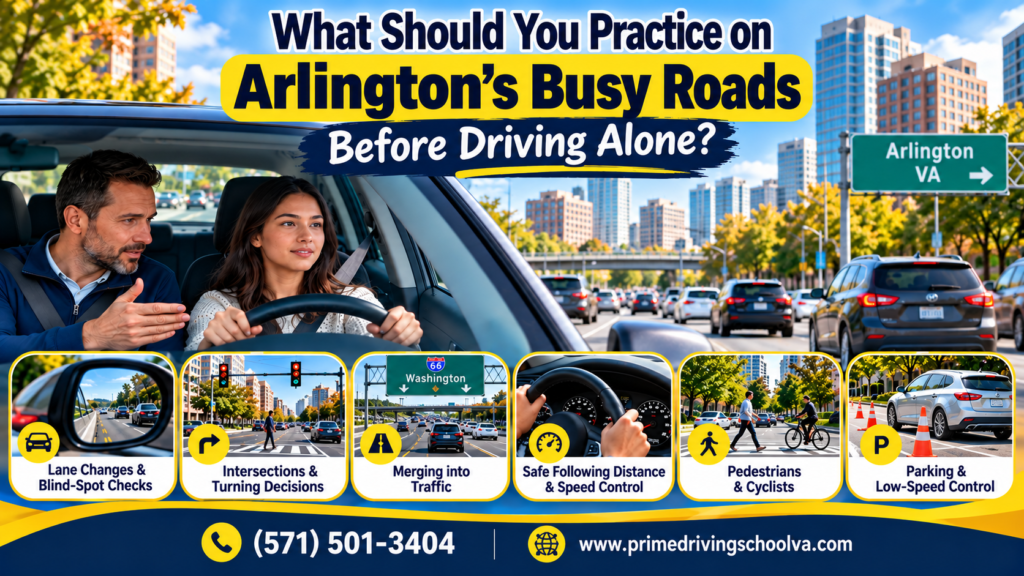
7 Skills to Practice Before Driving Alone
1. Lane Changes and Blind-Spot Checks
Lane changes become more important as traffic gets heavier.
Practice the complete process instead of focusing only on turning the steering wheel:
- Check mirrors regularly.
- Identify a safe gap.
- Signal before changing lanes.
- Check the blind spot.
- Move smoothly without sudden steering.
- Cancel the signal when appropriate.
A good driver learns to scan traffic before making a move rather than reacting at the last second.
2. Intersections and Turning Decisions
Intersections can challenge new drivers because several vehicles, pedestrians, signs, and signals may demand attention at the same time.
Practice left and right turns, controlled stops, yielding, and choosing the correct lane. Work on looking beyond the vehicle immediately ahead so you can recognize developing traffic problems early.
Virginia’s driver testing and licensing process includes knowledge and road-skills requirements depending on the driver’s age, education route, and licensing situation.
3. Merging Into Moving Traffic
Merging requires timing and awareness.
Practice judging traffic speed, finding an appropriate gap, checking mirrors and blind spots, and adjusting speed smoothly. Avoid stopping unnecessarily when a safe merge can be completed.
The purpose of practice is to make the process predictable. New drivers should learn to look ahead and make decisions early instead of waiting until the last moment.
4. Following Distance and Speed Control
A safe driver needs enough space to react when traffic changes.
Practice maintaining a reasonable following distance and adjusting it when weather, visibility, traffic, or road conditions change. Avoid copying the speed of the vehicle ahead automatically. Instead, pay attention to posted limits and current conditions.
Virginia DMV emphasizes safe driving techniques as part of the knowledge examination and driver education process.
5. Pedestrians and Cyclists
Arlington drivers regularly share road space with people walking and cycling. New drivers should practice scanning sidewalks, crosswalks, intersections, and turning areas.
Before turning, check for pedestrians and cyclists who may cross your path. Give yourself enough time to stop safely rather than making rushed decisions.
Virginia DMV notes that cyclists using roadways have general rights and duties similar to drivers, which makes awareness and predictable behavior important for everyone sharing the road.
6. Parking and Low-Speed Control
Parking may seem easier than highway driving, but it requires accurate vehicle control.
Practice:
- Parallel parking
- Reverse parking
- Backing in a straight line
- Pulling into parking spaces
- Checking surroundings before reversing
- Maintaining control at low speeds
These skills also help drivers understand the vehicle’s size, turning radius, and position.
7. Handling Unexpected Situations
You cannot predict everything that happens on a busy road. You can, however, practice how to respond.
An instructor can help learners work through situations such as sudden braking ahead, missed turns, heavy traffic, confusing intersections, or an unexpected pedestrian.
The focus should remain on staying calm, slowing down when needed, scanning the environment, and choosing a safe response.
How to Know When You Are Ready to Drive Alone
Being ready is more than completing a certain number of lessons.
Ask yourself:
- Can I maintain lane position without constant correction?
- Do I check mirrors and blind spots naturally?
- Can I handle intersections without panic?
- Can I merge into traffic safely?
- Can I recognize pedestrians and cyclists early?
- Can I park and reverse with reasonable control?
- Can I make safe decisions when traffic becomes busy?
- Can I recover calmly if I miss a turn?
If several answers are “not yet,” more supervised practice can help.
Virginia DMV states that a learner’s permit allows practice when the required licensed driver is seated beside the learner, subject to Virginia’s specific permit rules.
A Simple Arlington Practice Plan
A useful progression can start with quieter roads and gradually introduce more complex situations.
Stage 1: Steering, braking, turns, and lane position.
Stage 2: Intersections, parking, lane changes, and traffic signals.
Stage 3: Heavier traffic, multi-lane roads, merging, and pedestrian awareness.
Stage 4: Longer drives that combine several skills without constant instructor prompts.
This approach lets learners build skills progressively instead of trying to master every situation during one lesson.
Frequently Asked Questions
How much driving practice should I get before driving alone?
There is no single number that makes every learner ready. Skill level, experience, age, traffic conditions, and confidence all matter. Focus on consistent safe performance rather than counting lessons alone.
What should a beginner practice first?
Start with vehicle control, braking, steering, turns, lane position, and observation. Once these become comfortable, add intersections, parking, lane changes, merging, and heavier traffic.
Is highway practice important for Arlington drivers?
Yes, if highway driving forms part of your regular routes. Learners should practice merging, maintaining a safe following distance, checking mirrors, changing lanes, and managing speed under appropriate supervision.
Does driver education help with road-test preparation?
Yes. Virginia DMV states that approved driver education programs are designed to help students gain driving skills and experience and may include a road skills examination.
What are Virginia’s current learner-permit requirements?
Requirements depend on age and individual circumstances. Virginia DMV currently states that learners must be at least 15 years and 6 months old to apply for a learner’s permit. Additional holding-period and driver-education requirements vary by age.
Practice Before You Drive Independently
Driving alone should feel like the next step after you have developed reliable habits—not the first time you face busy traffic without support. Regular practice with an experienced instructor can help you improve observation, vehicle control, traffic awareness, and decision-making in realistic situations.
If you are looking for a Driving School Arlington VA learners can use for structured behind-the-wheel practice, focus on training that addresses the situations you actually expect to encounter on Arlington roads. The right practice plan can help you turn individual driving skills into safer everyday driving habits.