
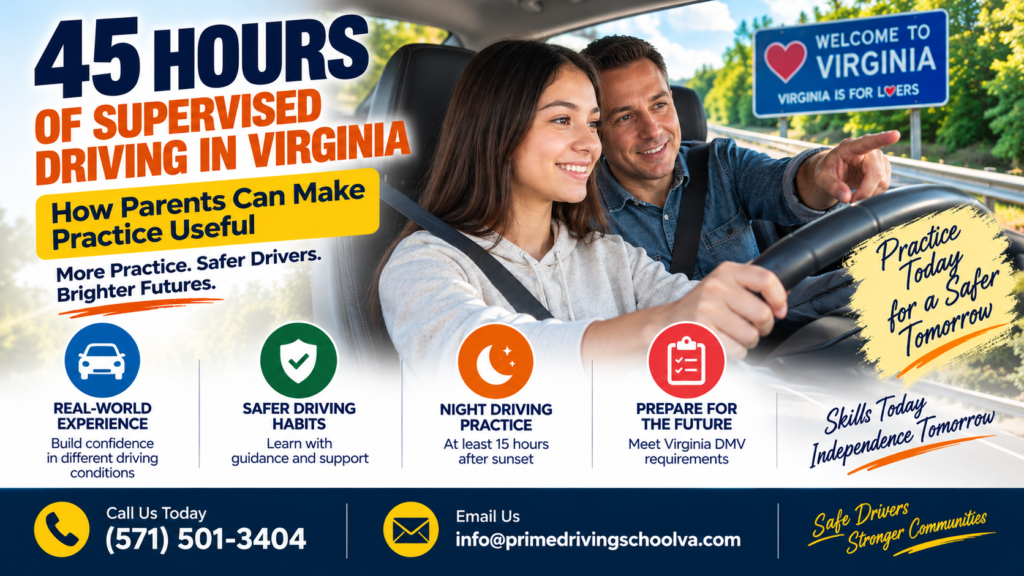
Getting a learner’s permit is an exciting step for a teenager. It also starts an important learning period for parents. In Virginia, teens under 18 generally need to complete 45 hours of supervised driving practice, including dmv approved driving school at least 15 hours after sunset, before they can move through the licensing process.
But 45 hours should mean more than simply sitting behind the wheel for a set amount of time. Parents can use each practice session to build better habits, improve decision-making, and prepare teens for real-world driving.
What Are the 45 Hours of Supervised Driving in Virginia?
Virginia requires teens under 18 to complete 45 hours of guided practice with a parent, guardian, or foster parent. At least 15 of those hours must take place after sunset.
The Virginia Department of Education provides a 45-Hour Parent/Teen Driving Guide to help families organize practice. The guide uses a gradual approach that moves from basic vehicle control and low-risk areas toward neighborhoods, traffic, highways, expressways, and more complex driving situations.
This progression gives parents a useful framework instead of asking a new driver to handle difficult roads too early.
How Parents Can Make Every Practice Hour Useful
Start With Basic Vehicle Control
The first practice sessions should focus on simple skills. Let your teen become comfortable with:
- Starting and stopping smoothly
- Steering
- Turning
- Using mirrors
- Signaling
- Maintaining lane position
- Controlling speed
- Parking
Choose a quiet location where your teen can focus without heavy traffic.
Increase Difficulty Gradually
Once your teen handles basic controls comfortably, move to neighborhood streets and roads with light traffic.
Then introduce more challenging situations such as:
- Busy intersections
- Lane changes
- Multiple lanes
- Heavier traffic
- Highway entrances and exits
- Different weather conditions
- Night driving
The Virginia Parent/Teen Driving Guide recommends progressing through different driving environments rather than treating all practice hours the same.
Make Night Driving Part of the Plan
At least 15 of the required 45 hours must occur after sunset. Parents should not leave night driving until the final few practice sessions.
Start with familiar roads after dark. Help your teen learn how headlights affect visibility, how to judge distance at night, and how to respond to reduced visibility.
As confidence improves, introduce more complex roads and traffic conditions.
Use a Simple Practice Plan
Parents can divide the 45 hours into smaller goals. For example:
Hours 1–10: Basic Skills
Focus on steering, braking, turning, parking, signaling, and basic traffic awareness.
Hours 11–20: Neighborhood Driving
Practice intersections, speed control, lane position, right-of-way, and residential traffic.
Hours 21–30: Busier Roads
Introduce heavier traffic, more complex intersections, lane changes, and different road layouts.
Hours 31–40: Highway and Advanced Skills
When the teen has developed sufficient basic skills, practice merging, following distance, highway awareness, and route planning.
Hours 41–45: Review and Confidence Building
Use the final hours to revisit weak areas and practice skills that still require improvement.
This schedule is only a planning example. Parents should adjust the pace according to the teen’s skill level.
Give Feedback Without Creating Stress
Parents sometimes become frustrated when a teen makes the same mistake several times. Try to keep feedback short and specific.
Instead of saying, “You are driving badly,” explain what needs to change.
For example:
“Check your mirror before changing lanes.”
This gives the student a clear action to remember.
Also, avoid giving too many instructions at once. Focus on one or two skills during each practice session.
Keep a Driving Log
Virginia requires parents or guardians to certify the required practice hours. Keep an accurate record of each session, including daytime and nighttime driving.
The Virginia Department of Education’s current 45-Hour Parent/Teen Driving Guide includes a sample practice log and instructions for documenting the hours.
Do not wait until the end to recreate the driving history. Record each session soon after it happens.
When Should Parents Consider Professional Driving Lessons?
Parents provide valuable practice, but professional instruction can add another layer of training.
A qualified instructor can help identify habits that family members may overlook. Professional lessons can also introduce structured practice for road-test skills, defensive driving, lane changes, parking, and highway driving.
Families searching for DMV Certified teen driving lessons Springfield VA can consider combining professional instruction with regular parent-supervised practice.
The goal is not to replace the 45 hours with professional lessons. Instead, professional training and family practice can complement each other.
What Should Parents Avoid During Practice?
Avoid turning every session into a road-test simulation.
A teenager needs to learn how to make safe decisions in everyday situations, not just how to complete a test route.
Parents should also avoid:
- Using a phone while supervising
- Giving unclear instructions
- Practicing difficult roads too early
- Criticizing every mistake
- Skipping night practice
- Ignoring weak skills
- Allowing distractions inside the vehicle
Parents should model the same safe behavior they expect from their teen.
Frequently Asked Questions
How many supervised driving hours does Virginia require?
Virginia requires drivers under 18 to complete 45 hours of guided driving practice, with at least 15 hours completed after sunset.
Can parents supervise the 45 hours?
Yes. Parent, guardian, or foster-parent involvement forms an important part of Virginia’s teen licensing process.
Do all 45 hours need to happen during the day?
No. At least 15 of the 45 hours must take place after sunset.
Should all 45 hours focus on road-test preparation?
No. Practice should develop broader driving skills, judgment, awareness, and safe habits. Road-test preparation can form part of the training but should not become the only goal.
Can professional driving lessons replace the 45 hours?
Parents should follow the current Virginia DMV and Virginia Department of Education requirements for supervised practice and certification. Professional lessons can provide additional structured training but do not automatically replace the required parent-guided practice.
How can parents make teen driving practice safer?
Start in low-risk environments, progress gradually, provide clear feedback, remove distractions, practice at different times of day, and use the Virginia Parent/Teen Driving Guide to structure sessions.
Final Thoughts
The 45-hour requirement gives Virginia families an opportunity to build real driving experience before a teenager becomes a licensed driver. The quality of those hours matters just as much as the number.
Parents can make practice more useful by following a gradual progression, recording every session, including night driving, and focusing on practical skills rather than only the DMV road test.
For families looking for nearest driving school near me Springfield VA, combining professional instruction with consistent parent-supervised practice can create a more structured learning experience. Always check the latest Virginia DMV requirements before completing the licensing process.
Ready to Build Safer Driving Skills?
Give your teen the confidence and practical skills they need to become a safer driver. Prime Driving School offers personalized driving lessons, behind-the-wheel training, and DMV road-test preparation for students in Springfield and surrounding Northern Virginia areas.
Call us today: (571) 501-3404
Email: info@primedrivingschoolva.com
Address: 8311 Timber Brook Ln., Springfield, VA 22153
Start your driving journey with Prime Driving School today!